James Clark Ross
Senior Clinical Scientist
CSC Wins the Trust's 'Future Ready' Award
7 September 2026
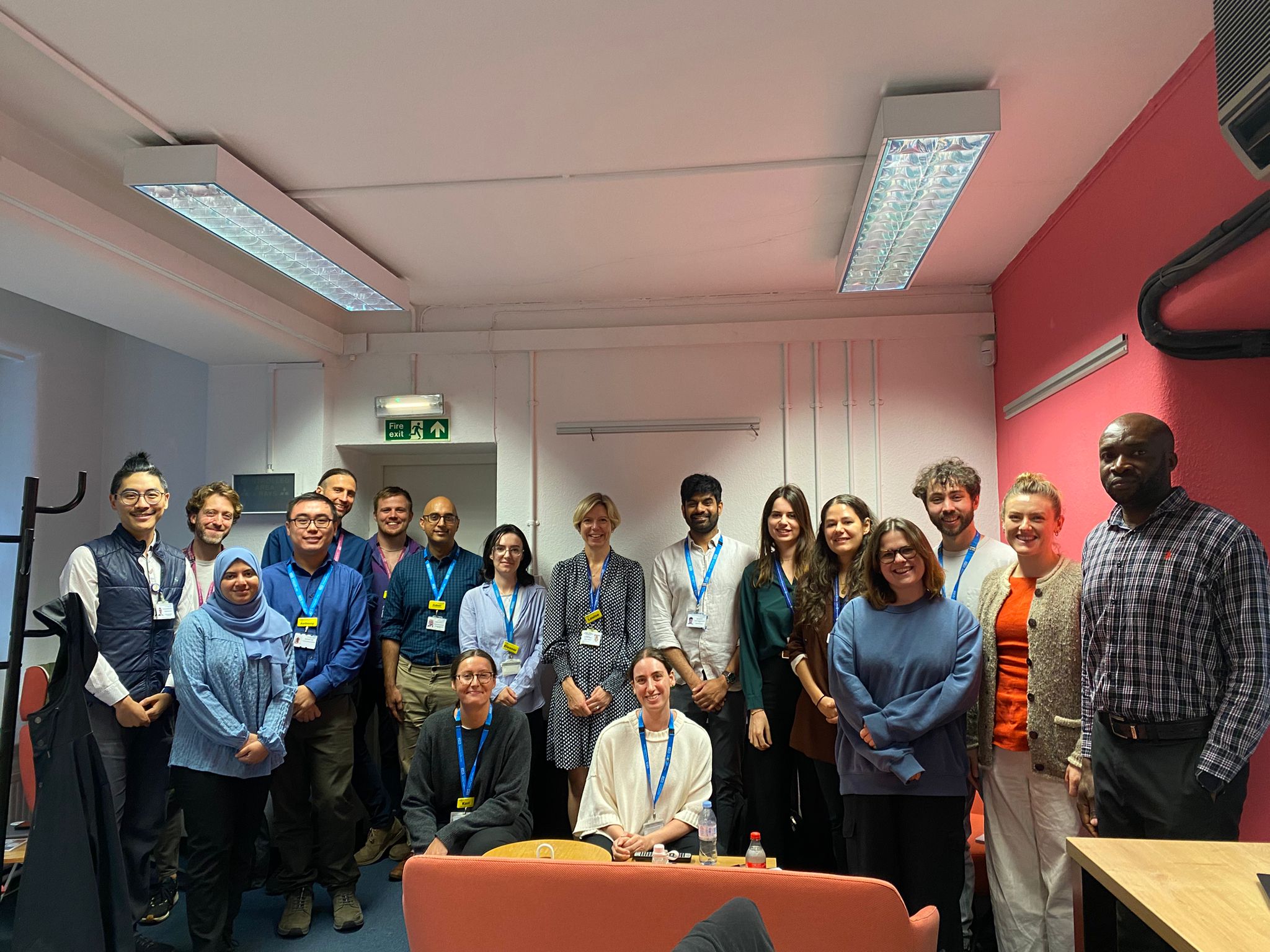
Featured image: Chief Executive of Integrated and Specialist Medicine, Louise Dark, along with Zubair Mustafa, recently visited CSC to congratulate the team on their Future Ready award. (L-R: Alexander Deng, Mikaël Simard, Zainab Qazi, Anthony Lim, James Clark Ross, Sam Porter, Zubair Mustafa, Keri Anderson, Eleanor Stylianides, Louise Dark, Poppy Cohen, Anil Mistry, Agathe Zecevic, Dika Vilić, Molly Buckley, Mike Woodward, Aoife Fox, Alfred Onuora.)
Clinical Scientific Computing (CSC) is proud to have received July’s ‘Future Ready’ award from the Trust. As part of the Future Ready campaign, Guy’s and St Thomas’ (GSTT) is recognising important contributions to the ways in which teams are responding to various challenges and opportunities ahead of us. CSC was rightly seen as a significant contributor to the Trust’s preparedness.
Writing about GSTT’s vision for the future of patient care in March, Chief Executive Amanda Pritchard emphasised the importance of the ‘Future Ready’ approach:
We’re continuously looking to improve the way we do things, which speaks to who we are as an organisation—we’re doing this because we want the very best for our patients, staff and communities. But these future plans can only happen if we also deliver the operational and financial commitments we make each year […] Getting ‘Future Ready’ is going to require a whole organisation focus on modernising and improving the quality of the care we provide while also being more efficient and reducing the amount of money we spend.
Chief Executive of Integrated and Specialist Medicine, Louise Dark, along with Deputy General Manager of Specialist Ambulatory Services, Zubair Mustafa, visited CSC on Wednesday 2 September 2026 to present July’s award to the team. This included several Future Ready badges.
During the meeting, various CSC projects that are driving efficiency savings within the Trust were discussed, including the following:
- CSC has developed and deployed a suite of neural networks to automate the segmentation of organs at risk for radiotherapy treatment planning. ‘AutoSegCT’ modernises a time-consuming clinical process and improves consistency.
- ‘EndominerAI’ uses a combination of natural language processing of endoscopy and pathology reports to optimise the timings of endoscopy follow-ups for patients with pre-cancerous conditions.
- ‘OsteoHand’ aims to opportunistically detect low bone density from hand X-rays in order to treat osteoporosis earlier and prevent fractures.
- ‘OsteoAI’, which is currently under development, is a neural network model that detects vertebral compression fractures and flags them to fracture liaison services.
- CSC is developing an in-house tool to track the Trust’s radioactive waste. By building it internally, the cost of acquiring a commercial product to do the same job has been avoided. The introduction of this tool will replace a legacy system that no-one was able to maintain. It can also be tailored to the specific intricacies of GSTT’s waste disposal processes.
- CSC has also built and deployed a post-deployment surveillance dashboard for monitoring the performance of clinical AI models.
These are only a few examples of how CSC has modernised and improved care for patients at GSTT and helped prepare the Trust for the future.
Follow us on LinkedIn for more updates on CSC activities.